Showing posts with label books. Show all posts

Thursday, September 27, 2012

Snippets of Making

I've already started working on the list for next week's List-it Tuesday--the topic is "creative things I could do in 15 minutes or less," and since most of the creative things I do are slotted into small pockets of time, this is perfect. You don't have to make a colorful, artsy list to participate, either. You can post a hand-written list or type it right into the blog post. I'm guessing lots of people who visit this blog are familiar with the concept of making use of the odd quarter-hour here and there. Perhaps you'll join in next week?

And of course I mention this because it leads right into what I'm posting about--some snippets of making that I've been able to do lately; the fact that I've gotten some creative play recently is helping my mood tremendously. Sunday afternoon I got in some sewing, just two more zippered pouches that were already cut and pinned, but it's amazing how much just the act of sewing them up made me feel so much more like myself. One was for my daughter, the long-promised pencil pouch, and the other hasn't reached its destination yet, but I'll be sure to share some pictures of it when it does.

I also created a handmade card this week. I started by layering some collage and paint on a 9x12" piece of Bristol board. Then I cut it into four pieces and added to one of the pieces to make my card (not shown). Here are the other three pieces, waiting to be worked into at some point and turned into more cards.


Also this week I borrowed the Artist's Journal Workshop from the library. I saw Jodi's review and immediately requested it through inter-library loan. It's a fantastic, inspiring book. I would love to create spreads like the ones shown in the book. The thing with drawing, though, is you only get better at drawing by...drawing. So I've been trying to sit down and draw.


That's the spray bottle that I use for artsy/crafty things. It's usually on the ironing board or the art table, and last night it was on the art table, so I drew it. The bottom is off--that curve on the left? all wrong. But how do you get better at drawing? By drawing. And oooh, do you see the date stamp at the top right? I can't explain why I wanted one so badly, but I did, and it turns out they cost less than $5 at Staples. Satisfying a want for less than $5 is pretty sweet.

Feeling prickly is a fairly good indicator that something is out of whack, and what's been out of whack is filling my well with some creative time. So, into the tiny slots of time it goes--a quick sketch, a layer of paint, whatever I can manage. It's that important.

Sunday, June 24, 2012

The Bedside Stack

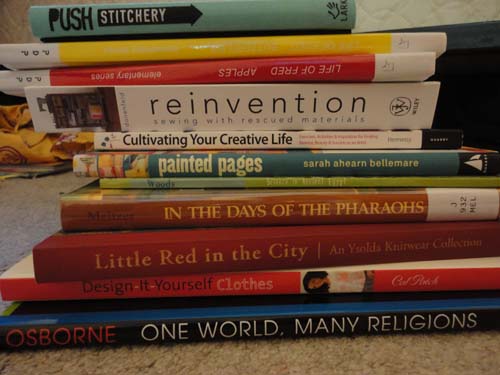
My bedside table is too small for a book, so my books tend to accumulate on the floor next to my side of the bed. Lately, it's gotten a bit out of control down there. I thought it would be fun to neaten up the stack a little and take a photo to share.

From bottom to top:

One World, Many Religions by Mary Pope Osborne. The kids and I are learning about world religions this summer, and I was pre-reading this book. The other book I'm using, Sacred Stories, was already out in the living room because we started with Buddhist stories. (Stories first, then some more factual background; that's my plan.)

Design-It-Yourself Clothes by Cal Patch. I bought this from Cal herself at the Squam Art Fair, but I think it's a bit beyond me. At least, every time I try to look through it, I get overwhelmed. I want to make a dress, but the dress uses one of the shirt patterns, so go make that first, it says, but that pattern is actually a modified version of another shirt pattern, and...I'll eventually try something from here. Maybe. I'd really, really like to feel competent enough to try, anyway.

Little Red in the City by Ysolda Teague. Also purchased at the Squam Art Fair, from Ysolda. I think I'll start with Cria. There is lots of useful information in here about fitting knitting patterns to your body and how to modify things, but it's hard to process because it's full of comma splices and run-on sentences. My husband makes fun of me when I say things like that, but I say, commas and periods send a different message to the brain. Periods are meant to come between separate complete thoughts (independent clauses, in grammatical terms). The ubiquity of run-on sentences is proof that many people's brains function just fine by stringing complete thoughts together without an end stop, but mine does not. (Also, no matter how common they are, they're still incorrect, grammatically, and have no place in a professionally published, beautifully designed book.) I may go through with a marker and edit it all, so I can read it without getting a headache. Other than that, useful book. Pretty patterns.

In the Days of the Pharaohs. From the library. I'm homeschooling* at least one child now (well, I suppose technically beginning in the fall, but I don't draw lines like that), and we'll be starting with ancient history. I checked this out to, well, check it out.

Science in Ancient Egypt. Same as above. I was intrigued by the title. I haven't read it all yet, so I can't tell you much about it.

Painted Pages by Sarah Ahearn Bellemare. I bought this a little bit ago in preparation for taking her online workshop next month. Exciting!

Cultivating Your Creative Life by Alena Hennessey. She gave a book talk at Squam one night, and I wanted to be supportive, so I bought her book.

Reinvention by Maya Donenfeld. She gave a book talk at the same time as Alena. I'd already decided I'd wait to buy this book from her in person. Her line was very, very long--which is why I went right from her table to Alena's. I want to start with some Tyvek projects, which means I need to remember how to log onto Freecycle and post to see if anyone has some they want to get rid of.

The first two Life of Fred books (upside down--whoops!). Again, pre-reading before sharing them with my eight-year-old, who, after three years of school, thinks he hates math.

Push Stitchery. Goodness, I ordered (and read through) this ages ago. It needs to find a home on a bookshelf!

*Herewith is the obligatory statement: I decided to homeschool because I feel it's the best thing for this particular child at this particular time. It's not a statement on what might be best for any other child or how I feel about his school or school in general. While the topic may trickle in here now and then, I have no intention of turning this into a homeschooling blog. This is my space.

So...have you been reading (or stacking) any good books lately??

Saturday, April 14, 2012

Poetry Forms for Kids + Other Curious Folk

One of the library branches we frequent had a nice display of poetry books in the children's room. Of course I grabbed several of them, including A Kick in the Head: An Everyday Guide to Poetic Forms by Paul B. Janeczko and illustrated by Chris Raschka. We all pretty much learn about sonnets and maybe odes in high school, and haiku and limericks in elementary school, and acrostic poems are pretty popular in the lower grades, too. But there are so many more! In between college degrees, I took some writing classes at a local adult learning center, where I had a fabulous instructor who taught me more about poetry than I'd learned in all of my schooling thus far. I learned about villanelles and pantoums in addition to sonnets and odes...and every form we encountered, we had to write one of our own.

I very much appreciated this thorough grounding in poetry types when I began my English degree. I also like the discipline required to try to write a poem with a strict form. Were my attempts great poetry? Um, no, I'm sure they were not. But attempting to take a thought, idea, or image, and fit it into a pre-set form...it's good practice. It requires really thinking and distilling and I think that's valuable, even if the result is never shared (as I won't be sharing that pantoum I wrote circa 1996).

This book is a good introduction to poetic forms for kids and adults, too. Each form includes at least one example, a fun illustration, and a short, to-the-point definition at the bottom of the page. At the end of the book, you'll find longer explanations of each form. Some of them were new to me, such as the triolet, which has a specific rhyme scheme (abaaabab) and repeating lines: 1, 4, and 7 are the same, and 2 and 8 are the same. The poem I'm sharing today, which is from A Kick in the Head, is a triolet.

The Cow's Complaint
by Alice Schertle

How unkind to keep me here
When, over there, the grass is greener.
Tender blades--so far, so near--
How unkind to keep me here!
Through this fence they make me peer
At sweeter stems; what could be meaner?
How unkind to keep me here
When, over there, the grass is greener.

Monday, March 12, 2012

Sketching at the Zoo

Monday's weather was supposed to be fabulous--and it was! Over 60 degrees at home, and ten degrees warmer in the city, where my daughter and I spent the day at the zoo. She's been asking to go for a while, and here I was, with a beautiful weather day and no plans. The bathroom, in dire need of cleaning, was ignored. To the zoo! With sketchbooks!

Over the weekend, I received an Amazon order. (My husband and I were jointly given a $50 Amazon gift card for Christmas. He turned it over to me.) It included Drawing Lab: 52 Creative Exercises to Make Drawing Fun For Mixed-Media Artists. I don't know if I'm an artist, never mind a mixed-media artist, but I do want to get in the habit of drawing daily, and I wanted some fun prompts. I love this book already. One of the "labs" is to sketch at the zoo. Why had I never thought of that before? There are several tips on how to approach moving animals, including gesture drawings (of course) and starting drawings and going back to them when the animal returns to that pose, but...no tips on how to do this with a three-year-old along... (this is only a sampling of the sketches, many of which were even less successful...clicking should make them a little bigger)

Chickens
I brought her sketchbook too, and gave it to her while I tried to sketch chickens. Chickens move fast, and mostly they were showing us their back ends, pointed up to the sky while they pecked. While this was amusing, and rather characteristic, I think, of a chicken, it got old fast. Unfortunately, I used up my daughter's interest in her own drawing with the uncooperative chickens.

Fish
I did a little better with these fish, which were (a) inside a building and (b) really interesting to my daughter, who loves fish. I was only able to sketch a bit of that scale pattern, enough to remind me to see if I can find more photos of this type of fish online, and maybe mimic that pattern via stamping.

Super quick (maybe a minute, if that?) gesture drawing of my daughter watching the tortoises.

Three-year-old human
Three-year-olds move at least as fast as chickens. {And, you know, ignore that hand.}

I really wanted to sketch the camels, from the minute I thought of bringing my sketchbook along. Camels have such personality. When we got to that exhibit, one's back was to us and the other's face was hidden behind a tree. Eventually I found a decent vantage point, and then realized that these animals, which looked at first glance to be completely motionless and lying down, never stopped moving. Up, down, shift, move a leg, stretch the neck, every time I tried a quick line contour and came back to where I thought I'd begun, I was somewhere else. (Good Picasso-style camels, I suppose.) Finally I quickly managed this:

Camel
...and looked up, only to realize my daughter was several feet down the path, climbing the wall. (Look at that horrible mother, letting her child get away while she...what is she...drawing? What the hey?!)

I gave up on the sketchbook after that! But it was still fun, and something to perhaps try with my older kids, another day. I've already shared another "lab" from this book with them, turning watercolor blots into creatures. This was my result:


I explain how we did it and share the boys' work, too, here.

Like I said, I'm completely loving this book so far! It's so much fun, not stressful drawing at all, which is what I wanted. I have taken drawing classes, a very long time ago, and I enjoyed them very much (and was better at it than I thought I would be, at the start), but it's been years and you sort of lose confidence in the connection between your eye and your hand. So something fun is a good way to get back into a drawing habit.

ETA: Taking Karen's suggestion, I linked up with Paint Myself Pretty's do-it-together Drawing Lab link thing.

Tuesday, February 28, 2012

Happiness Vessel

A little story about me... at various times in my life, I've had issues with depression. I believe, but may be wrong here, that I was only ever officially diagnosed with depression in childhood, and that ever after--those times I bothered to see someone, that is--it was always called something else, like adjustment disorder or something like that. Regardless, I was given absolutely no coping strategies as a child, no tools of self-awareness so that I wasn't caught broadside later on, nothing helpful at all. (Whatever issues I still have with THAT whole experience, we'll leave out.) But that's not the story I'm telling you. This story takes place in my very early 20s, beginning with my senior year of college.

I was living a 45-minute drive away from my university and commuting each day. My job--one of them--was almost as long a drive in the opposite direction, which means my job--one of them--and my classes were nearly as far apart from each other as you can get in this, the smallest state. I was living by myself in a really cute apartment--I'll give it that--but before that, I'd been living with a boyfriend, and the not-living-together had not been my choice. My apartment, which admittedly was really very cute, was in an old, old house, and when the winter winds blew they moved my curtains, because the windows were drafty and the house had no insulation. My heating bill was about $150 per month (in the early 90s!) and that was just to stay alive, not be warm or anything. Gas was cheap then, so I'd get into my car and drive around just to run the heat. It's good gas was cheap, because I was spending an awful lot of time driving: back and forth to work, or other work, or, for a time, other work--for a stretch there I had three jobs--and back and forth to school, where I was carrying full-time credits while, at times, working 30 hours per week.

I was sad. I was cold. I was exhausted. Sometimes, driving back to the city from class, I'd approach the infamous (around here) Thurbers Avenue curve and think, If I just got into a little accident, I'd get to rest for a little bit, and the hospital would be warm, and they'd feed me. Okay, I thought this more than "sometimes." And lack of coping strategies or not, I knew this wasn't a good thing. So I decided I would notice at least one thing each day that made me happy and write it down. It could be a small thing, but I had to notice it, and I had to write it down. I wrote down things like "had a dollar to get coffee between work and school" and "buds on the trees" and "the snow is melting" and "got a letter from a friend today." (Remember when decent coffee cost a dollar? Remember when letters came in the mail?)

This was almost two decades ago (lordy, I'm getting old). Before the Internet blew up, before self-help books everywhere, before Dr. Phil Bobby Oz Joe Smith was on every talk show. I don't know where this idea came from. I think the universe took pity on me and stuck it in my head, and luckily, I listened. Writing down happy things is not a substitution for high-powered tools against depression; I'm not saying that at all. But it got me looking up and out, out at the world around me rather than down and in, trudging through the same up early, to work, to school, to work again, cold, tired, to bed, start all over again rhythm of my days.

You know what? I graduated from college and got a job...waitressing full time. I was still cold in the winter, I was still tired, I still got sick a lot, I had no sick days, and a run of bad winter weather on weekends could blow up my budget. I still felt it necessary to write down my happy things.

After a while the habit became so ingrained that I didn't have to write them down anymore, although I periodically returned to it when I felt the need. I do, I do, I do notice the small things. The small things are the happy-making things. The things right in front of your face. Oh, big things make me happy too. I am, daily, grateful for this life, this normal, regular life, with a husband and three kids and money for coffee whenever I want, plus books and yarn and art supplies and fun extras for the children. Imagine! For years I couldn't imagine any of that. I am deeply thankful. But I believe noticing the small things leads to contentment.

True: One day, with my third baby strapped to my chest (because she wasn't happy and wouldn't sleep anywhere else), I achingly, carefully knelt down to fold another basket of laundry. I am grateful we have a working washer and dryer, I thought. I'm thankful I'm not worrying about how to pay for new clothes when my kids outgrow these.

Do I sound like Pollyanna? I'm not. I'm cynical and sarcastic and yell too much and I'm tired all the time, still. I read that book as a kid. I wanted to be that good. I'm not. But I try to take notice. If the small things don't create happiness, you know, the big things won't either, because nothing will ever be big enough. That's my guess, anyway. And some days (like yesterday), the first happy thought that comes to mind is "I'm glad this day is over."

Yes, I'm writing down my happy thoughts again...because the Squam store offered these beautiful gratitude journals and I couldn't resist.


And even though I'm in the habit of noticing throughout my day, I like the idea of writing it down again, so I can look back at all my happy-making moments.

And that is my story of learning the habit of noticing the small moments that create a contented life.

How about you? Do you have a similar habit?

Monday, February 20, 2012

What's On My {Creative} Bookshelf

Last week (or so), Feeling Stitchy posted about Hoopla! The Art of Unexpected Embroidery. I immediately put it on my Amazon wish list (otherwise known as "where I keep track of books I want to buy myself, because nobody else ever checks my wish list, ever"). But I also checked my local library system, and they not only had copies, but there wasn't a hold wait-list, either, so I got the book sent to my nearest branch super quick. And then I devoured it. I still plan on buying it, because I need my own copy. This embroidery book speaks to me.

I've been embroidering for less than a year; I decided I needed to learn so I could add some poetry to a pair of jeans. And while I've embroidered other people's patterns, I rather quickly moved to wanting to embroider my own drawings, the gist of my thought process being, If I can draw, why am I embroidering other people's drawings? Likewise, I seem to have moved along from wanting to use embroidery only as adornment or in the process of making something useful, to viewing floss on fabric as another choice of medium for expressing an idea--in other words, as an artistic representation in its own right. This is how I ended up stitching tree branches for two weeks. I could have rendered that in paint or pastel or charcoal...but I wanted to do it with thread.

There's definitely a risk with that choice. Stitching floss into fabric takes time, and there's a chance that at the end, you just won't be happy with the result. If there's a way to make a sketch in floss, I don't know about it. On the other hand, embroidery supplies are inexpensive, compared to other hobbies and other art media. Needles? Super cheap. Hoops, floss, all inexpensive. Fabric? That doesn't even have to be purchased; you can stitch on repurposed items. Even the least expensive (yet still workable) water color set and a pad of watercolor paper is going to cost more than what you need to get started with stitching--never mind acrylics or oils or even a nice set of drawing pencils.

So back to Hoopla: it's not the patterns that draw me in, although there are some fantastic ones--but I don't see myself re-creating someone else's artistry anytime soon. It's the interviews, with loads of people who are using embroidery to express their artistic vision, in sometimes unexpected ways. I'm not drawn to all of those ways, of course; we each have our own tastes. But I am inspired. Some inspiring people in particular:

Annie Coggan Crawford embroiders maps (amongst other things) on furniture--such as the military movements of Ulysses S Grant. (Aside: I was taught, as a copy editor, not to place a period after the "S" in Grant's name because it didn't stand for anything.) I was hoping to find a link to an online gallery of her embroidery work, but I'm having no luck. You can see a glimpse of one piece here.

Ray Materson taught himself embroidery in prison. I've seen his work online, but I didn't know his story, some of which is in his interview in the book. It's fairly powerful. (And his embroidery is amazing, too.)

Also included are goddess portraits stitched by Sasha Webb, another new-to-me name, in floss she dyed herself using natural dyes--to take the time-intensive nature of embroidery up a notch, yes? (The colors are just gorgeous, and perfect against the linen background.)

This piece is by Kirsten Chursinoff, who (like me!) is drawn to sea life, although these, of course, are plants.

Photo of Ernst Schneider's photo of Kirsten Chursinoff's Moonlight Umbels, from Hoopla!


And I love this blend of science and art by Aubrey Longley-Cook (who went to our local art school):

Photo of Aubrey Longley-Cook's photos of his own pieces from the series Zombie Zoology, from Hoopla!
And last, I'll leave you with an inspiring (to me, anyway) quote, from the interview with Penny Nickels:
If you have an interesting idea, you may be the first person to create it with embroidery. I can't think of another art from where that is a possibility.
I was already working on ideas with embroidery, but now I'm teeming with many more to sort through and try. It's a slow process, stitching. You live with the work for a while; it's not something you can finish in a day, even a long day. When I was taking classes towards an art minor, I don't think any professor ever suggested fabric and thread as a medium. It took me this long to make the connection, that what I have in my mind's eye could possibly be expressed through slow and careful stitching, and that this is so much more interesting to me than paint or charcoal. What a giddy, liberating connection to make.

Friday, November 18, 2011

What's On My {Knitting} Bookshelf

My newest knitting-related book purchase:


Coastal Knits by Alana Dakos and Hannah Fettig. Why? Because I figure any pattern book with "coastal" right in the title is probably going to be a good fit for me, that's why! I didn't pre-order it, preferring to wait to see if any store near me would be stocking it (and thus not only buy local but save the shipping cost), and hurrah! I was able to buy it at one of my local yarn stores. This makes me doubly happy, because I'm not a very good yarn store customer, because I already have so much stinking yarn. (By all rights I should never buy sock yarn again.) So I'm happy for the opportunity to buy a pattern book, at least, from the local store, because it's the only place locally that sells Cascade 220, and I don't want it to go out of business. (When I need Cascade 220 because it's hat-and-mitten-knitting-season again, it's so nice not to have to wait for it.)

So, back to the book. I've read some grumblings here and there because it's not available to download, but I have to say, it's very lovely to look at, and I'm not sure an electronic copy would do it justice. (Although I wish it were spiral bound. All pattern books should be!) Alana lives in California, and Hannah in Maine, and they're both influenced by the natural environments around them when designing. Each pattern has an intro/inspiration/story board preceding it.

As someone who is drawn to and inspired and really grateful for the natural places where I live--also on the East Coast, a little further south from Maine--I like this addition. There are many lovely cardigans in this collection, but I'm thinking this is probably the one I'd make first:

The Water's Edge Cardigan, although I'd quibble with the assertion that it's a cardigan for all seasons. It looks like a late spring/early fall cardigan to me, and I'm not sure I wouldn't lengthen the sleeves even so, but then I'm shivering from October through April.

And then there's this little shawlette. I can't imagine when or where I'd wear this...

...but I want to knit it. It's the Sand and Sea Shawlette, and I'd need that exact yarn in those exact colors, simply to mimic the sand and sea. Every time I have my camera at the beach, I try to capture the chevron-like pattern the in-and-out of the waves leaves on the sand before it's washed away again, because I want to try to re-create the pattern in a knitted something that then flows into something else that mimics the foamy wave curling over the sand. But, right, I haven't quite gotten to that yet. Did you know, Alana and I taught ourselves to knit the same year (2002)? Sometimes I think I'm just plain doing something wrong, that I can't manage to do anything with my ideas... maybe if I'd taught myself to knit before I had the first kid...

So, that's what's on my {knitting} bookshelf. But the reality is I most likely won't be knitting anything from it anytime soon. I'm still working on mittens, and my daughter picked out yarn and then decided (when shown some options) that Like Sleeves For Kids would be a good use for it. And I kind of want to knit myself something crazy-stupid-easy to crawl into; it's been that sort of a week month.

Or maybe I'll just knit myself a little piece of sand and sea to tide me over...

Friday, November 11, 2011

What's On My {Fiction} Bookshelf

Earlier in the school year my oldest came home with the Scholastic Book order form, excited to tell me that the new Rick Riordan book was available for pre-order. Not only that, but he spent his own money to buy it. He was even more excited the day the order arrived and he got to bring The Son of Neptune home, where he promptly fell into it, not resurfacing until he was done. At that point, he brought it to me... and when I caught up on the library books I was reading, I read it too.

The Son of Neptune is the second book in the second series of books featuring Percy Jackson, who is a demigod (one immortal parent, one mortal parent) and the son of Poseidon. The first series focuses on Greek gods and demigods. This second series brings in the Roman aspect. It's fun, there's a lot of mythology, it's completely unrealistic, there's a lot of slaying monsters and improbable heroics in battle by a bunch of teenagers, and did I mention it's fun? My son loves the books and they spark his imagination, and I like that there are books that he reads that I enjoy reading too, because then we can talk about them. My husband is next in line to read it, when he's done with one of my son's library books from another series that they both enjoy (but I've never read; not my style).

A family of readers...oh, it's so much fun.

Also this week, I've been reading The Chronicles of Prydain out loud for the nth time. My younger son chose the series as his bedtime books (when we read to him) when he finished with the Bone series. The set of books we have dates to my own childhood. I think I requested them for Christmas one year. They're starting to fall apart, actually. I've read them out loud several times, beginning with my oldest--they are wonderful read-aloud books. I've had sick kids all week, so I've spent a lot of time reading aloud to my 7yo while he rested on the couch. My older son would put his own book down to listen to the familiar stories, and my daughter would snuggle next to me, and we all listened as another set of heroes, in a very different time and setting than Percy Jackson and his friends, fought against their own foes.

So far, I've managed to stay healthy...which means, of course, that I have plenty of voice to read aloud. So that's what's on my {fiction} bookshelf this week...what's on yours?

Friday, November 4, 2011

What's On My {Creative} Bookshelf

I learn about lots of wonderful books through reading blogs--knitting and sewing books, books to use with and for my children, creativity-inspiring books... so as part of my goal of 30 posts in 30 days, I decided to share what I'm reading each week. This week I'm focusing on three creative books, all borrowed from the library, one requested and two just found. (Don't you love found books?)

Image from Amazon.com
I requested The Creative Habit: Learn It and Use It For Life by Twyla Tharp. I've seen it mentioned here and there, most recently on a Craft Social post, and I thought it was time to give it a read. For anyone who doesn't know, Twyla Tharp is an American dancer and choreographer. She quite rightly (in my opinion) feels creativity is a habit, not a lightning stroke of luck from who-knows-where-all. I'm about halfway through the book. Right at the start I marveled at her morning ritual/way to start the day (and thus get the creative juices flowing). She wakes up at 5:30, gets dressed to work out, hails a taxi, and gets herself to the gym for a two-hour workout. She prefers to start her day getting warm because she is a dancer--makes perfect sense. Her ritual is part of her preparation for work.

Then I thought about how I begin my day. I get out of bed at 6:30--although I'm often awake before that, and perhaps have already fetched my youngest when she awoke, helped her to the bathroom, and taken her back to my room. I get into the shower. I get dressed, I pack two lunches, I get two kids off to school. Somewhere between 8 and 8:10 I can sit down with a cup of coffee; if I'm lucky I can drink it instead of pouring it into a travel mug and heading out somewhere else with my youngest. The start of my day doesn't lend itself to feeling creative. It mostly makes me grumpy.

She does mention that her "dumbest" idea was thinking she could have it all. (She has one child.) "I set out to have a family, have a career, be a dancer, and support myself all at once, and it was overwhelming. I had to learn the hard way that you can't have it all, you have to make some sacrifices, and there's no way you're going to fulfill all the roles you imagine...[w]hat makes it stupid is that I set up a way of working that was in direct conflict with my personal ambition. Something had to give." She doesn't mention (in that passage, anyway) what gave. I'm curious, though.

Source: www.joyceraimondo.com
Turning on a dime here, the next two books are ones I found in the art section of the kids' room while my youngest was at the library for story time. Both are by Joyce Raimondo, and I feel a bit abashed that I hadn't known of these books beforehand. I borrowed Express Yourself! Activities and Adventures in Expressionism, and Picture This! Activities and Adventures in Impressionism. I am a bit passionate about providing open-ended, process-oriented art activities for my kids (and sharing what we do here, in hopes of inspiring others to do the same). The activities in these books are sufficiently open-ended that I think they might need to end up as Christmas presents so I don't have to remember the activities I wanted to try with the kids.

My philosophy of art-with-children is very much biased towards freedom, exploration, and self-led creativity. I love finding an inspiring book or two. And if you happen to live near Long Island (if only we had a boat, I bet we could get there in no time from here!), she offers classes and workshops, some of which are at the Jackson Pollock House (I want to visit!!). We also have Action Jackson out of the library at the moment. When I finished reading it to my three-year-old, the first thing she said was, "When can I paint like that?" I'm working on that one--and I love that she asked!

So, are you reading any inspiring books at the moment?

Friday, June 10, 2011

Review: Sewn by Hand

Note: I purchased this book myself, through Amazon.


The first thing I ever sewed, whatever that was, was by hand. My mother had a sewing machine, but she never taught me how to use it, and I didn't sew with a machine until nearly three years ago, when I bought a Pfaff for my 35th birthday. Before that, I was fairly against sewing for a while, even knitting sweaters in the round to avoid sewing up. ("If I wanted to sew," I'd say, "I'd be sewing, not knitting.") I had to hand-sew a zipper into a Tomten I knit and it was fairly torturous and laborious.

And then I decided to sew a couple of Waldorf dolls from kits (by hand), and I figured that made me a sewist. And then I got the Pfaff. And then, much later, I decided to learn embroidery, and now, depending upon the project, I'm just as likely to choose to sew by hand as use the machine. So when this book came out and I failed to win a copy in any of the many blog giveaways I entered, I bought it.

Why do I choose to sometimes sew by hand? For a smallish project, like a cuff or a needlebook, it's often easier to sew it by hand than to wind a bobbin, if necessary, and thread the machine just to get started. Sometimes the project demands it, like patching the knees of my sons' pants. I often feel like I have greater control over the small bits if I'm doing it by hand. I can sew upstairs, sitting in my chair, talking to my husband and watching the Red Sox. Or I can more easily sew while my kids are playing around me, and interrupt my work without much fuss. But until I began learning embroidery, I didn't really know one stitch from another, and like with most handcrafts, I'm cobbling together knowledge as I go.

But look at the Table of Contents in this book!

Essential Tools and Useful Thoughts: Lovely to have, especially the Gallery of Hand Stitches, and I'm not embarrassed to say that my knots need work and this book tells me how to do better. For those of us who are teaching ourselves how to knit, sew, and whatever else we want to do, a resource right, shall we say, at hand is both essential and useful, as billed. Even if I don't make any of the projects, I have a feeling the book will be quite worth it as a reference tool alone.

I do want to make some projects, though. I like the Thread Caddy (follow the link to download the pattern for free at the Lark website). I also like the Button-Up Tote, which comes with directions on how to make your own fabric-covered buttons. (The possibilities there are dizzying to me.)


And can you imagine hand-sewing curtains? Not too long ago I said out loud that while I had no problem sewing many things by hand, curtains, well, of course I'd use the machine for curtains! And then I saw these:


Sheer curtains, sewn with silk ribbon. So pretty, and really, it doesn't look that hard, and how else to sew curtains with silk ribbon if not by hand? I don't think I have one room in my house that is worthy of such pretty, delicate curtains, but I may just allow the kitchen to put on airs and make a sweet little cafe curtain that I can admire while I wash dishes.

So there you have it, my unbiased opinion of this book--while it has a few things I'd never make, it's full of information and I feel it was a good purchase. Usually I check out sewing and knitting books through the library before buying them, but I took a leap on this one and ordered it sight unseen. I'm glad I did.

***
What about you? Do you ever sew by hand, or do you prefer the machine for everything? (Or do you avoid sewing as much as possible, as I used to?!)